Directional Drilling in Greater Austin
A city that split itself on a fault line: limestone hills west, blackland farms east, the Colorado running between — and a decade of growth that never let the utilities catch up. Catching them up is HDD work. It's ours.
HDD is the whole job here
Austin drilling is two trades separated by a fault system. West of the Balcones line — roughly where MoPac climbs — the metro rides Edwards and Glen Rose limestones: hard, karstic Hill Country rock that makes every bore a rock bore. East of I-35 the ground drops into Taylor and Blackland clays — the farm dirt now sprouting gigafactories — which drill fast and swell with the seasons. The interesting alignments cross the line, and the honest quotes price both sides as what they are.
South of the river adds a layer with its own initials: the Barton Springs segment of the Edwards Aquifer, where the city and state regulate anything that could touch the recharge zone feeding the most beloved swimming hole in Texas. Bores there carry written fluid-containment and void procedures as a matter of local law and local politics alike — we build them that way by default.
The demand never slows: a manufacturing corridor stacking fabs and suppliers through Williamson County and out toward Taylor, FTTH racing subdivisions south through Hays, and a municipal electric and water system hardening itself in between. The national desk behind this site — 50,000+ boring calls, ~10,000 crossings quoted, 2,000+ drilled — prices it all with the pattern library that scale builds.
Fiber-Optic Boring
FTTH, backbone, and fab-corridor duct across the fastest-wired metro in Texas.
Electrical Duct Boring
Feeders, campus power, and grid-hardening duct across a municipally powered metro.
Water & Force-Main Boring
System crossings for a metro sprinting to keep water ahead of rooftops.
Colorado River & Creek Crossings
The signature Austin bore: under the dammed reaches and the spring-fed creeks.
Road & Highway Crossings
City, county, and TxDOT crossings priced by which ground your pavement sits on.
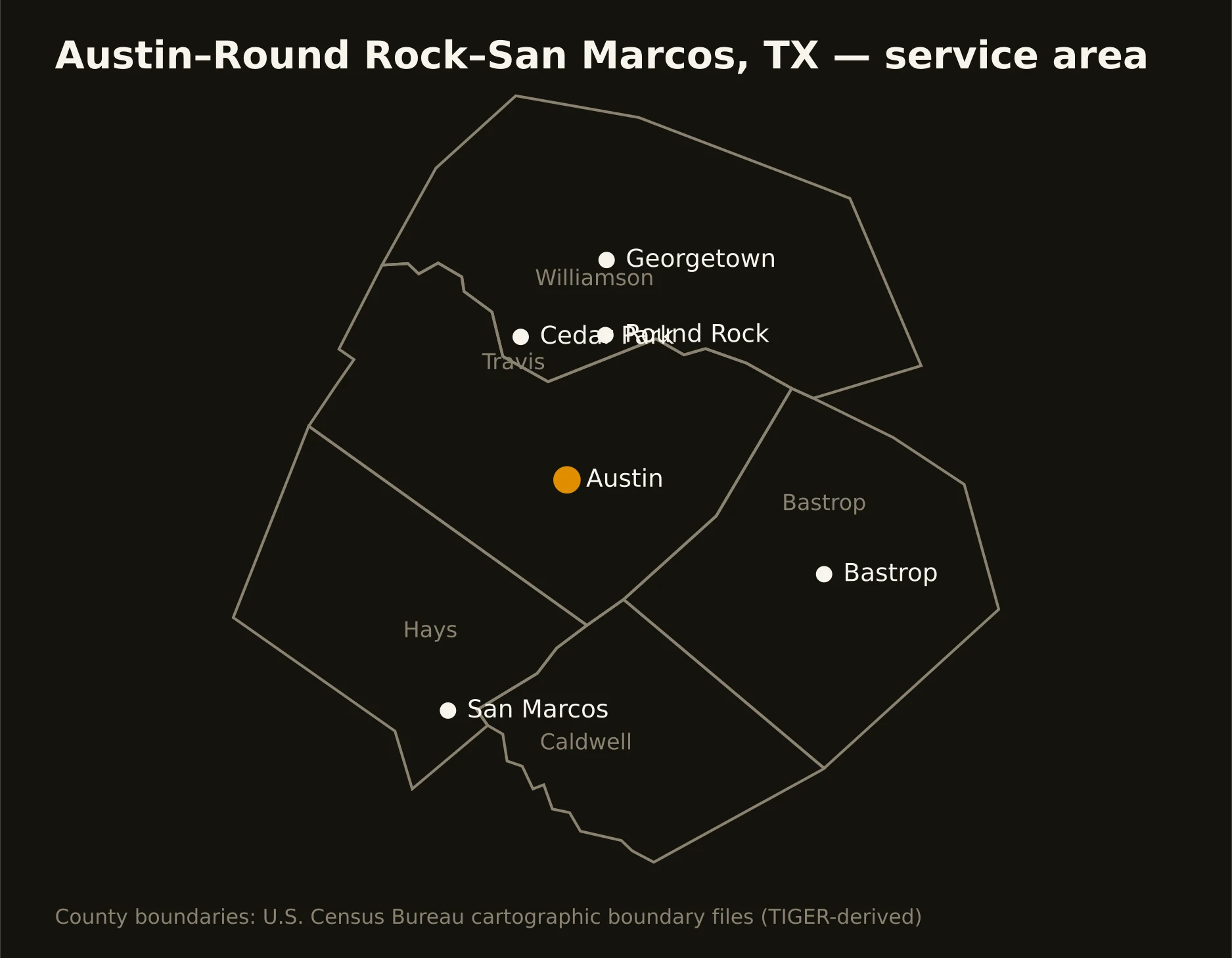
Five counties — Travis, Williamson, Hays, Bastrop, Caldwell — spanning the sharpest ground transition in Texas metro drilling, plus the manufacturing corridor pulling the metro's center of gravity northeast. Full county list on the service-area page.